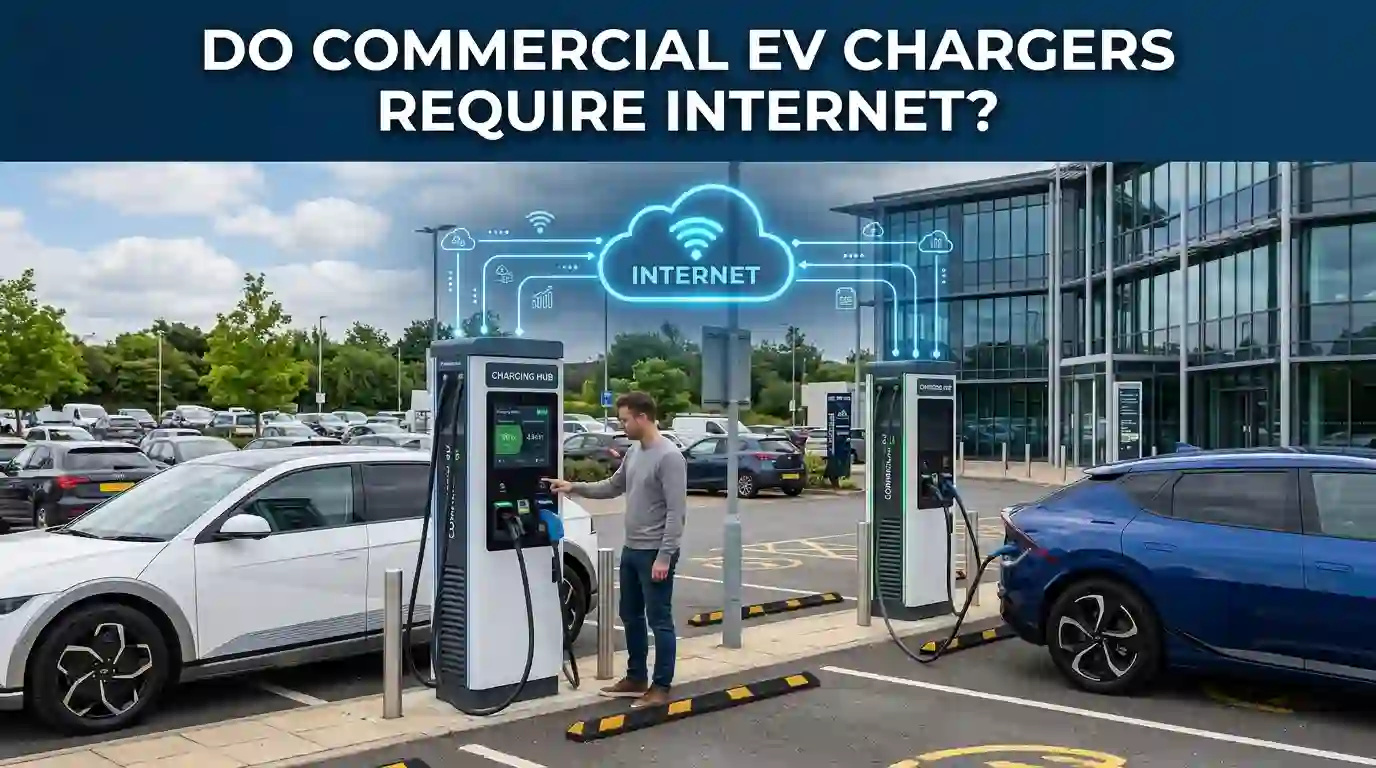
The short answer is no, but yes. A commercial electric vehicle (EV) charger can technically deliver electricity without an internet connection. However, a “dumb” charger is increasingly rare in a world demanding smart, reliable, and profitable infrastructure.
The reality is that for a commercial charger to function as a modern, user-friendly, and revenue-generating asset, an internet connection is virtually essential. Let’s explore the spectrum of connectivity, from the “dumb” offline charger to the fully “smart” networked station.
The Offline Reality: Charging Without the Web
It is indeed possible for commercial EV chargers to operate without an internet connection. This is crucial for certain use cases where connectivity is a challenge.
- Remote or Difficult Locations: In underground garages, remote parks, or secure facilities like government sites, internet access can be limited, expensive, or a security risk .
- Offline-Enabled Hardware: Some chargers are designed with offline capabilities. For example, the Wallbox Pulsar Plus, when integrated with Liberty Plugins’ CodeConnect, allows for access control and payment via time-based session codes without needing a live network . Similarly, the Watti Pro Lite S can manage up to 100 users via RFID cards entirely offline .
- Basic Operation: A charger can function in a “Plug & Play” mode, where any vehicle can be plugged in and start charging without any authentication or communication with a central system . This is often seen in private, workplace, or residential settings where charging is provided as a free amenity.
In these offline scenarios, the charger’s job is purely to deliver electricity. It cannot report its status, process credit card payments, or be managed remotely.
The Smart Connection: Why the Internet is Key for Commercial Success
For a public-facing commercial charger, the internet is not a luxury; it’s the backbone of the operation. The value proposition of a commercial charger is built on connectivity . The industry is moving towards creating an exceptional driver experience, and that begins with a reliable connection .
Here’s what an internet connection enables for a commercial charger:
- Reliable User Authentication & Payment: The core of a commercial model. To take payments and manage access, a charger needs to communicate with a backend network to authorize users. While offline RFID is possible, networked solutions allow for app-based payments, credit card processing, and dynamic billing . This is critical for generating revenue and recouping the investment in the charger.
- Remote Management and Monitoring: Charge Point Operators (CPOs) often manage hundreds or thousands of chargers. An internet connection allows them to monitor the health of each unit, run diagnostics, perform over-the-air (OTA) firmware updates, and troubleshoot issues without a costly site visit . This dramatically reduces operational costs and downtime.
- Data-Driven Smart Features: The “smart” in smart charging comes from data. Networked chargers can participate in load balancing to avoid overloading a building’s electrical grid, optimize charging schedules based on energy prices, and integrate with smart city infrastructure . This data is also invaluable for understanding usage patterns and making strategic decisions about where to install new chargers.
- Enhanced User Experience: Connectivity enables features that drivers have come to expect, such as checking a charger’s availability in real-time via an app, receiving alerts when charging is complete, or even using the station’s Wi-Fi hotspot . These features build brand loyalty and attract more users.
Bridging the Gap: When the Network Fails
The paradox of the “connected” charger is that internet reliability remains a significant issue. Studies have shown a public charging failure rate of around 20%, with connectivity being a leading cause .
This has led to innovations designed to provide the “best of both worlds.” For example, Loop Global’s Infinity Link technology allows chargers to operate offline by authorizing sessions locally. The charger can still start a session and record all its data, and it will simply synchronize all the payment details and session logs with the central network once connectivity is restored . This ensures business continuity and a seamless user experience even when the internet is down.
Conclusion: Connectivity is the Standard
The question isn’t whether a commercial EV charger can work offline—it’s whether it should. For a simple, private, and free charger, the internet is optional. However, for any charger that needs to generate revenue, be managed efficiently, and provide a great user experience, a robust internet connection is non-negotiable.
As the industry matures, the trend is clear: commercial EV charging is moving towards a fully connected, smart ecosystem . The most successful deployments will be those that treat internet connectivity with the same importance as the electrical supply, using a mix of Ethernet, Wi-Fi, and 4G/5G cellular connections to ensure high uptime and reliability .