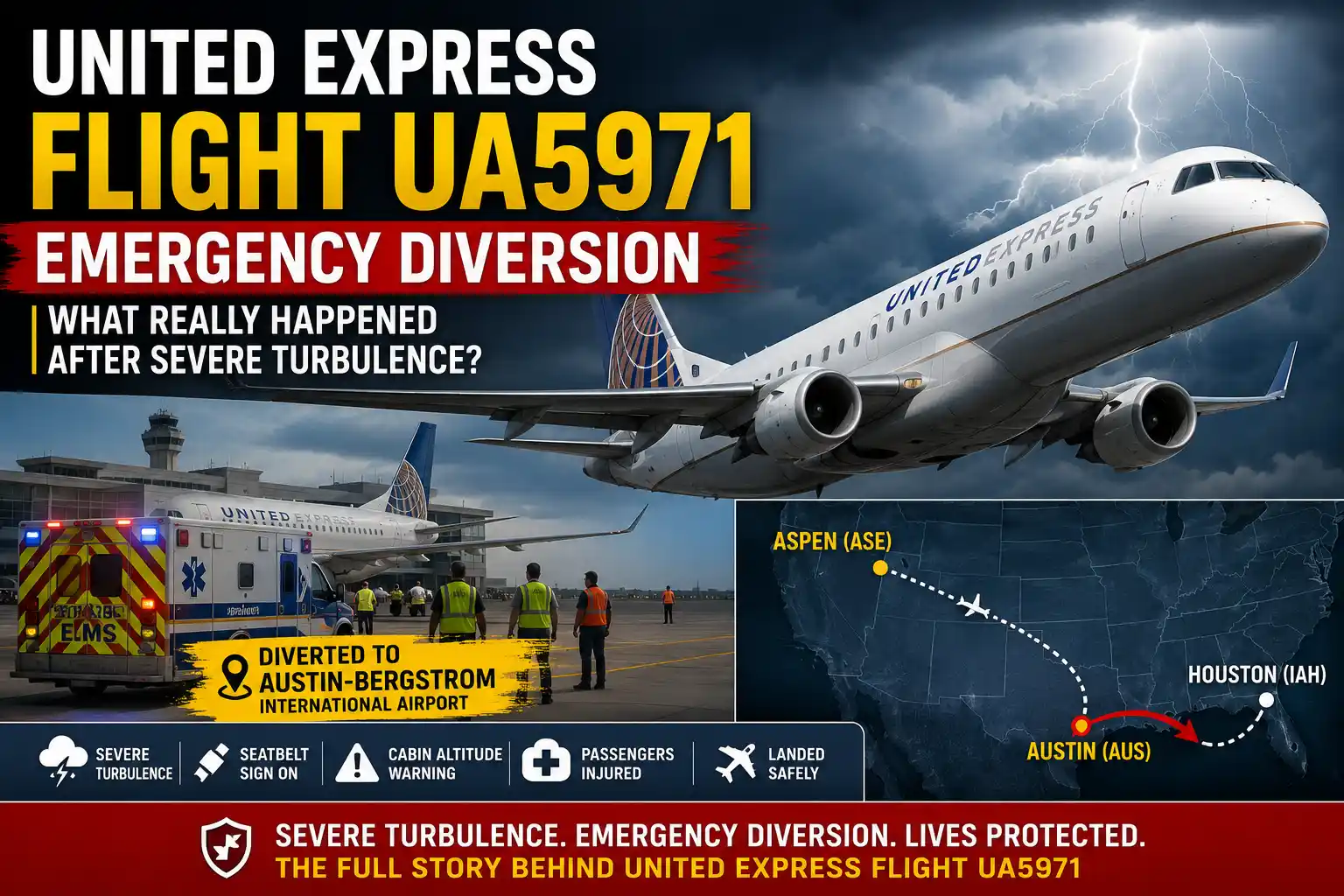
United Express Flight UA5971 emergency diversion became a major aviation topic after the aircraft encountered severe turbulence during a scheduled flight from Aspen, Colorado, to Houston, Texas. The flight did not continue to Houston. Instead, the crew diverted to Austin-Bergstrom International Airport after the turbulence event, a cabin altitude warning, and injuries onboard.
The flight landed safely, but the incident raised serious questions for people: Why did the aircraft divert? Was it a crash? Were passengers hurt? What did officials find later?
Here is the clear answer based on verified reports and official findings.
Quick Answer: What Happened to United Express Flight UA5971?
United Express Flight UA5971, operated by SkyWest Airlines for United Express, was flying from Aspen/Pitkin County Airport to George Bush Intercontinental Airport in Houston when it encountered severe turbulence over Texas. After the turbulence encounter, the crew declared an emergency and diverted the aircraft to Austin-Bergstrom International Airport.
The aircraft landed safely in Austin. Medical teams met the plane after arrival, and injured passengers were taken for care. The official investigation later focused on convective turbulence, the seatbelt sign being illuminated, a passenger being out of their seat, and a cabin altitude warning that followed the turbulence event.
Read More: Practice Basketball System Zuyomernon
Details of the UA5971 Emergency Diversion
| Detail | Information |
| Flight | United Express / SkyWest Flight 5971 |
| Route | Aspen, Colorado to Houston, Texas |
| Diversion Airport | Austin-Bergstrom International Airport |
| Aircraft | Embraer E175 / ERJ 170-200 series |
| Main Event | Severe turbulence during cruise |
| Emergency Code | Squawk 7700 reported during the diversion |
| Medical Response | Emergency medical teams met the aircraft |
| Official Finding | Convective turbulence caused serious injury to a passenger who was out of their seat |
Timeline of the United Express Flight UA5971 Incident
The flight started as a normal regional service from Aspen to Houston. The crew had already considered possible weather issues on the route, and extra fuel was added in case weather deviations were needed.
While the aircraft was en route, air traffic control allowed deviations around weather in the area. The seatbelt sign was on because of the weather-related route changes.
The aircraft then encountered sudden severe turbulence at cruising altitude. The event was strong enough to throw people who were not properly secured. Crew members began emergency procedures, and the aircraft later received a cabin altitude warning.
After that, the crew initiated an emergency descent and diverted to Austin. The aircraft landed safely, and medical personnel responded at the gate. Read More: Dirty Ways to Make Money Online
Why Did UA5971 Divert to Austin?
UA5971 diverted to Austin because the flight crew needed to manage an emergency situation after severe turbulence. The aircraft was no longer just dealing with a rough ride. There were injuries onboard, emergency procedures were active, and the crew had to choose a safe airport where medical support could meet the aircraft.
Austin-Bergstrom International Airport became the safer operational option. A diversion in this type of case does not mean the aircraft crashed or lost control all the way to landing. It means the crew changed the destination to handle passenger safety, aircraft checks, and medical response as quickly as possible.
What Caused the Emergency Diversion?
The main event behind the United Express Flight UA5971 emergency diversion was severe convective turbulence. Convective turbulence is linked to thunderstorm activity and unstable air. It can happen suddenly and may be difficult to avoid completely, even when crews are watching weather carefully.
After the turbulence encounter, the aircraft also received a cabin altitude warning. The crew put on oxygen masks and performed an emergency descent. A later examination found an outflow valve malfunction related to cabin pressure control.
The safest way to describe the incident is this: UA5971 diverted after a severe turbulence encounter, followed by a cabin altitude warning that required emergency procedures.
Were Passengers Injured on UA5971?
Yes, passenger injuries were reported. Medical personnel met the aircraft after it landed in Austin, and two passengers were transported to the hospital. The NTSB report later described one passenger as having serious injuries after being out of their seat during the turbulence encounter.
This detail is important because the seatbelt sign was illuminated at the time. The incident shows why passengers are told to keep seatbelts fastened whenever seated, even when the flight feels calm.
Turbulence can arrive faster than a person can react. A passenger standing in the aisle or using the lavatory is more exposed during a sudden turbulence event.
What the Official Investigation Found
The official investigation found that the aircraft encountered convective turbulence while flying at cruising altitude. The flight crew had briefed for possible weather issues, and the seatbelt sign was on because of weather deviations.
The report noted that the turbulence was sudden and unanticipated. One flight attendant was in the aisle, another was in the forward galley, and two passengers were out of their seats at the time. One passenger later received serious injuries.
After the turbulence, the crew received a cabin altitude high warning. They followed emergency procedures, descended to a safer altitude, diverted to Austin, and landed without further incident.
The official probable cause focused on the aircraft’s encounter with convective turbulence, which resulted in serious injury to a passenger who was out of their seat while the seatbelt sign was illuminated.
What “Squawk 7700” Means in This Incident
Squawk 7700 is a general emergency transponder code. Pilots use it to tell air traffic control that the aircraft needs priority handling.
In the UA5971 incident, the emergency code helped controllers understand that the aircraft needed urgent attention during the diversion. It does not automatically mean the aircraft was crashing. It means the crew had declared an emergency and needed support from air traffic control.
Severe Turbulence vs Normal Turbulence
Normal turbulence can feel uncomfortable, but it is common in flying. The aircraft may shake, bump, or move slightly as it passes through uneven air.
Severe turbulence is different. It can make movement inside the cabin dangerous. Loose items may move, standing passengers can fall, and unbelted passengers may be thrown from their seats.
That is why the UA5971 incident became serious. The danger was not only the aircraft movement. The real risk was what happened inside the cabin when people were not fully secured.
Why Seatbelts Matter Even When the Flight Feels Normal
A seatbelt is not only for takeoff and landing. It protects passengers from sudden movement during cruise.
The UA5971 emergency diversion is a clear reminder that turbulence does not always give enough warning. Even when the sky looks calm from a passenger window, weather systems and unstable air can still affect the aircraft.
Passengers should follow a few simple rules:
Keep your seatbelt fastened while seated.
Do not ignore the seatbelt sign.
Avoid standing during active weather.
Secure laptops, bottles, and loose items.
Use the lavatory only when conditions are safe.
Listen to flight attendant instructions quickly.
These steps cannot prevent turbulence, but they can reduce injury risk.
Common Misinformation to Avoid About UA5971
Several aviation incidents get exaggerated online. UA5971 should be described carefully.
It was not a crash.
There was no indication of a fatal accident.
Engine failure was not confirmed in any official reports.
It was not a mainline United Airlines aircraft.
It was a SkyWest-operated flight flying as United Express.
Not every passenger was injured.
The aircraft landed safely in Austin.
The main official finding involved convective turbulence and passenger injury.
Using accurate wording matters because aviation incidents can spread quickly with dramatic but incorrect claims.
What This Incident Means for Future Travelers
This incident does not mean flying is unsafe. It shows how aviation safety systems work when something unexpected happens.
The crew declared an emergency, coordinated with air traffic control, descended when needed, diverted to a suitable airport, and landed safely. Medical teams then responded on the ground.
That is exactly why diversions exist. A diversion is not always a sign of disaster. Many times, it is the safest decision available.
For travelers, the main lesson is simple: stay belted when seated and take crew instructions seriously.
Final Summary
United Express Flight UA5971 emergency diversion happened after a SkyWest-operated United Express flight from Aspen to Houston encountered severe turbulence over Texas. The crew declared an emergency, handled a cabin altitude warning, diverted to Austin, and landed safely.
Medical personnel met the aircraft after landing, and passenger injuries were reported. The official investigation later found that convective turbulence caused serious injury to a passenger who was out of their seat while the seatbelt sign was on.
The incident is a strong reminder that turbulence can become dangerous inside the cabin, especially for anyone standing or unbelted. The best passenger habit is simple: keep the seatbelt fastened whenever seated, even during cruise.
Read: StayConnect App
Read: InfinitAI Reviews
FAQs
What happened to United Express Flight UA5971?
United Express Flight UA5971 encountered severe turbulence while flying from Aspen, Colorado, to Houston, Texas. The crew declared an emergency and diverted the aircraft to Austin-Bergstrom International Airport.
Why did UA5971 divert to Austin?
UA5971 diverted to Austin after severe turbulence, passenger injuries, and a cabin altitude warning. Austin allowed the aircraft to land safely and receive medical support.
Was UA5971 operated by United Airlines?
The flight operated as United Express, but it was operated by SkyWest Airlines, which flies regional services for United.
Did United Express Flight UA5971 land safely?
Yes. The aircraft landed safely at Austin-Bergstrom International Airport after the emergency diversion.
Were passengers injured on UA5971?
Yes. Medical personnel responded after landing, and two passengers were transported to the hospital. The official report described one serious injury.
What aircraft was used for UA5971?
The flight was operated by an Embraer E175, also part of the ERJ 170-200 series family.
What does squawk 7700 mean?
Squawk 7700 is a general emergency code used by aircraft to alert air traffic control that priority handling is needed.
What was the official cause of the UA5971 incident?
The official probable cause focused on convective turbulence that seriously injured a passenger who was out of their seat while the seatbelt sign was illuminated.
Was UA5971 a crash?
No. UA5971 was not a crash. It was an emergency diversion after severe turbulence, and the aircraft landed safely.
What can passengers learn from this incident?
Passengers should keep seatbelts fastened while seated, follow crew instructions, avoid standing when the seatbelt sign is on, and secure loose items during flight.