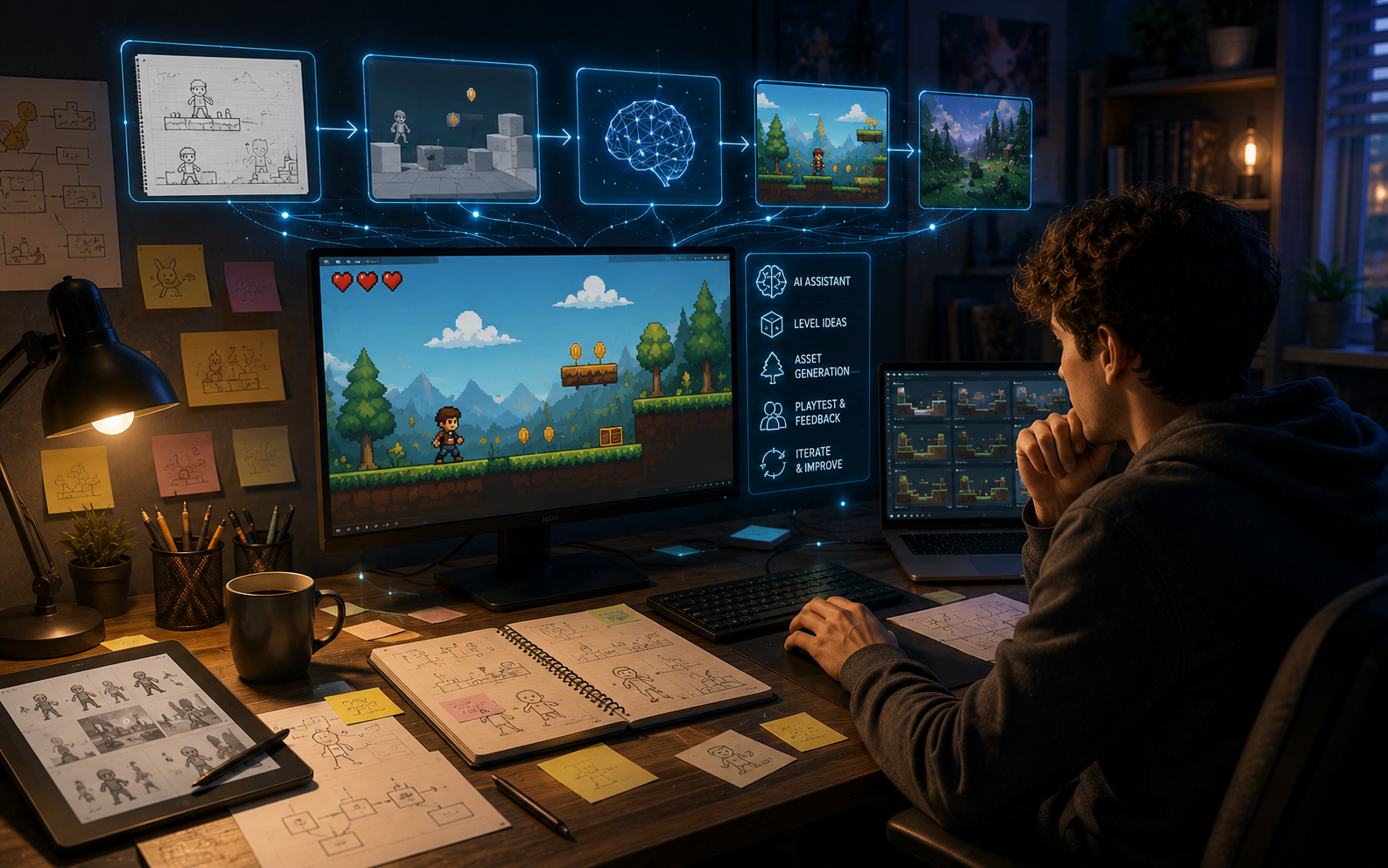
A first game is rarely anyone’s best game. That’s been true for decades, long before AI entered the picture. What’s changed recently isn’t that first attempts have become perfect, it’s that first-time developers now have tools that catch obvious mistakes earlier, iterate faster, and produce noticeably more polished results than a first solo attempt used to manage.
This isn’t about AI doing the work for beginners. It’s about removing enough friction that a first project has a real chance of turning out good, not just finished.
Why First Games Traditionally Struggled
Too Much to Learn at Once
A first-time developer without AI-assisted tools traditionally had to learn programming fundamentals, engine-specific quirks, asset creation, and game design principles all simultaneously. Struggling with syntax errors left little mental bandwidth for actually thinking about whether the game was fun.
No Feedback Until Much Later
Traditional development often meant weeks of invisible progress before anything was playable enough to test. By the time a first-time developer could actually evaluate whether their idea worked, they’d already invested heavily in a direction that might need significant rework.
Mistakes Were Expensive to Fix
Discovering a core mechanic wasn’t fun after building an entire level around it meant redoing substantial work. That expense discouraged experimentation, which is exactly the wrong lesson for someone still learning what makes a game good in the first place.
How AI Changes the First-Project Experience
Immediate Feedback Instead of Delayed Discovery
Create a game platforms let first-time developers see a working version of their idea almost immediately, which means discovering a mechanic isn’t fun happens in the first session, not after weeks of invisible progress. That earlier feedback loop is arguably the single biggest advantage AI offers beginners specifically.
Lowering the Technical Learning Curve
Removing the requirement to learn programming syntax before testing an idea means first-time developers can focus their limited attention on design, the part that actually determines whether a game is good, instead of splitting it between design and debugging code.
Making Experimentation Cheap Enough to Actually Do
Because testing a variation costs less time with AI-assisted tools, first-time developers can afford to try different approaches instead of committing to the first idea simply because starting over felt too expensive. Games like Retail Tycoon reflect what can come out of that kind of process, a well-paced management loop that likely benefited from testing several approaches before landing on what worked.
What Beginners Still Need to Learn
Design Judgment Doesn’t Come From the Tool
AI can generate a working mechanic quickly, but it can’t tell a first-time developer whether that mechanic is actually fun, fair, or well-paced. That judgment still has to be developed through playtesting, observation, and honest self-assessment, the same as it always has.
Scope Discipline Is Still a Skill
Faster tools don’t automatically prevent scope creep. First-time developers still need to learn to keep a project small enough to finish, since ambition naturally outpaces available time regardless of how quickly implementation happens.
Understanding Why Something Works Matters
Getting a working prototype quickly is different from understanding why a mechanic feels good. First-time developers benefit from slowing down occasionally to ask why a particular version felt better than another, rather than just accepting whatever worked without examining the reasoning behind it.
Practical Advantages for Beginners Specifically
Reduced Fear of Starting
One of the biggest barriers for first-time developers has always been the intimidation of an empty project. Starting from a plain-language description instead of a blank code editor removes a meaningful psychological barrier, making it easier to actually begin instead of endlessly planning without building anything.
More Room to Make Mistakes Safely
Because iteration is cheap, first-time developers can make more mistakes without paying a heavy cost for each one. Mistakes are how design intuition actually develops, and cheaper mistakes mean more of that learning happens per project.
Faster Path to a Finished, Shareable Project
Finishing a first project, even a small one, teaches more than any tutorial could about scope, testing, and publishing. AI-assisted tools shorten the distance to that finish line, which means beginners reach the valuable lessons that come after shipping much sooner than they used to.
A Realistic Approach for First-Time Developers Using AI Tools
- Start smaller than feels necessary. The goal of a first project is finishing it, not proving ambition.
- Use AI to reach a playable version fast, then slow down. Speed gets you to something testable. Improving it still takes deliberate, unhurried attention.
- Playtest constantly, even informally. Ask a friend to try it within the first week, not after months of private refinement.
- Pay attention to why changes improve the game. Building intuition matters more long-term than any single project turning out well.
- Finish it, even if it’s rough. A completed small game teaches more than an ambitious one that never ships.
Final Thoughts
AI hasn’t made game development effortless for beginners, and it was never going to. What it has done is remove enough of the technical burden that first-time developers can spend more of their limited attention on the parts of development that actually build lasting skill: design judgment, iteration, and understanding what makes something fun.
The first game still won’t be anyone’s best. But it’s increasingly likely to be a genuinely good starting point, one that teaches real lessons instead of getting lost in technical struggle before a single meaningful design decision even gets made.