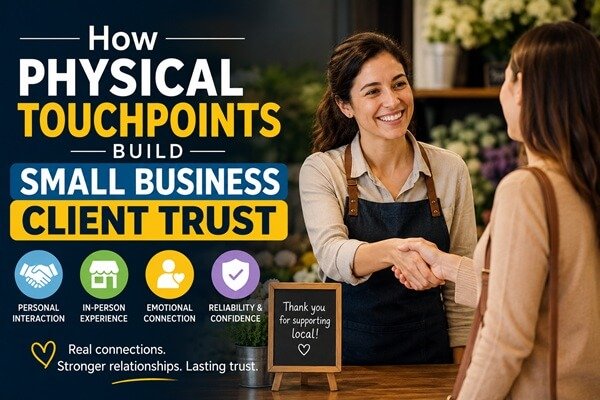
Most small business owners spend thousands on a website and almost nothing on what clients touch during an actual meeting. That is backwards. The moment a prospect sits across the table from you, the screen they browsed last Tuesday disappears from memory. What they see, feel, and hold right now is doing all the work.
Physical touchpoints are not a nostalgic workaround for businesses that haven’t gone digital. They’re a deliberate trust signal, and the ones who figure that out tend to close more deals and keep more clients.
Why the Tangible Still Outranks the Digital in Client Meetings
Here’s the dynamic most people underestimate: trust is built through the senses, not just through logic. Before your prospect weighs your pricing or evaluates your service offering, their brain has already filed a judgment about you based on everything they’ve observed in the room.
A 2026 meta-analysis published in Personnel Psychology by researchers at the University of Florida’s Warrington College of Business found that the three strongest factors driving first impressions were communication style, physical appearance, and what researchers call “content cues.” Notably, content cues, meaning what you’ve actually said or written, turned out to be the weakest of the three predictors. According to lead researcher Brian Swider, Ph.D., this finding held across 204 independent samples from 145 studies of first impressions in workplace settings.
In plain terms: your pitch matters less than the atmosphere around your pitch. A polished, branded physical environment signals competence before you say a word. Conversely, a generic manila folder and a printed Word document can undercut even a strong proposal.
The 3-Layer Credibility Stack
After working through how small businesses actually lose deals they should win, a pattern emerges. Call it the 3-Layer Credibility Stack. Every client interaction sits on three layers, and most businesses only manage one.
- Layer 1 — Digital presence: Your website, social media, and email signature. Most businesses invest here heavily.
- Layer 2 — In-person behavior: How you show up, how you communicate, how you listen. Moderate investment from most.
- Layer 3 — Physical artifacts: What clients hold, take home, and look at again. Almost universally underfunded.
Layer 3 is where the gap lives. It is also the layer with the longest shelf life. A proposal emailed as a PDF gets skimmed once, maybe twice. A well-printed branded folder sitting on a client’s desk gets picked up every time they sort through their stack.
A Real Scenario: Ridgeline Advisory’s Discovery Day Problem
Picture a three-person management consulting firm, Ridgeline Advisory, that specializes in operational audits for mid-size manufacturers. Their discovery day meetings consistently went well by verbal measures. Prospects liked the team. Questions were thorough. Callbacks, though, were slow.
The problem surfaced during a debrief with a prospect who eventually did sign. She mentioned that two competing firms had given her “actual packets” to take home, while Ridgeline had sent a follow-up PDF. She had to dig through her inbox to find it. The other folders were sitting on her credenza.
Ridgeline made one change: they added a branded presentation folder to every discovery day, containing a one-page firm overview, a customized project scope draft, and a client reference sheet. Within two meetings, a prospect commented on how “organized and professional” the packet felt. Callbacks shortened. That single Layer 3 shift cost them under $3 per meeting.
What to Actually Put in a Client-Facing Folder
The physical container matters, but so does what goes inside it. A branded folder stuffed with generic tri-fold brochures misses the point. The materials need to feel assembled specifically for that prospect.
A practical content layout for a first-meeting folder:
- A personalized cover insert with the prospect’s company name and the meeting date. Takes sixty seconds to print, makes the whole packet feel bespoke.
- A one-page company overview with your differentiators, not your mission statement. Prospects don’t remember mission statements.
- A relevant case study or reference from your most comparable client. One page, specific outcomes, no jargon.
- A next-steps card that spells out what happens after today if they decide to move forward. Reduces ambiguity, which reduces anxiety.
- Your business card tucked in the slot. If the folder has a business card slot, use it. It’s the one piece they’ll pull out the most.
The folder itself should match your brand colors, not default to the printer’s house stock. That is the difference between a folder that says “we printed something” and one that says “we thought about this.” When ordering, using personalized folders with your exact brand palette ensures the container does as much work as the content inside it.
Print’s Trust Advantage Is Measurable
The intuition that print feels more credible has data behind it. According to data compiled by WorldMetrics, 75% of consumers find print marketing easier to read and more trustworthy than online content, a gap that holds even as digital adoption accelerates.
That trust differential matters most at high-stakes decision moments. Buying a software subscription is low-stakes. Hiring a contractor, signing a retainer, or approving a six-figure proposal is not. The higher the stakes, the more a prospect reaches for tangible evidence of competence. A physical, branded packet is that evidence made literal.
When to Use Physical Materials and When to Skip Them
Not every interaction warrants a printed folder. Here is a quick decision guide:
| Situation | Physical Folder? | Why |
| First in-person client meeting | Yes | First impression window is open; shelf life matters |
| Proposal delivery for a deal over $5,000 | Yes | Stakes justify the material; digital alone feels underweight |
| Recurring check-in with an existing client | No | Trust is already built; a folder here feels like an upsell attempt |
| Virtual-only relationship | Mail it | A mailed folder is memorable precisely because no one else does it |
| Cold outreach drop-off | Yes | It’s the physical leave-behind that differentiates you from a business card |
Getting the Details Right Without Overthinking It
Two finish decisions shape how a folder lands: coating and stock weight. A gloss finish makes colors pop and photographs read with more depth, which works well for creative agencies, real estate teams, and anyone whose brand lives on visuals. A matte or soft-touch laminate feels premium in the hand, which works better for consultants, financial firms, and legal service providers where gravitas matters more than flash.
Stock weight affects whether the folder feels substantial or flimsy. A folder that bends when you hold it by its edge says something. Not something good. Most professional print runs use 14pt stock as a baseline. If your brand leans toward luxury positioning, bump to 16pt.
Order more than you think you need. Per-unit cost drops significantly at volume, and the worst version of this story is running out of folders the week before your biggest pitch of the quarter.
“Content cues were the weakest predictors of first impressions. What somebody has said about you, what your resume says, the content of what you say in initial interactions is not as impactful as the other two cues.” — Brian Swider, Ph.D., University of Florida Warrington College of Business, Personnel Psychology, 2026
That quote is not just about job interviews. It applies to every client meeting you’ll have this year. The words you prepare are necessary. But the physical environment you create around those words does more than most business owners ever invest in. Closing that gap is one of the cheaper decisions a small business can make, and one of the more durable ones.