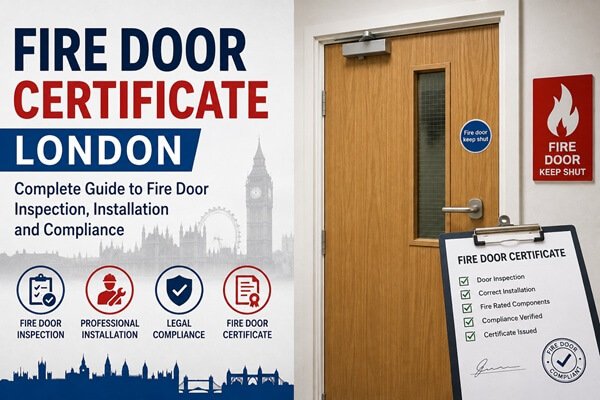
Fire doors are an essential part of a building’s passive fire protection system. When correctly specified, installed and maintained, they are designed to resist the spread of fire and smoke for a defined period, helping protect escape routes, maintain compartmentation and support the building’s overall fire strategy.
However, simply having a door that looks like a fire door does not mean it will perform correctly during a fire. Excessive gaps, defective self-closing devices, damaged seals, unsuitable hinges, poor installation and unauthorised alterations can all affect the performance of a fire-resisting doorset.
For landlords, property managers, businesses and Responsible Persons looking for a Fire Door Certificate in London, a professional fire door inspection provides a documented assessment of existing doors and identifies defects requiring remedial work or, where necessary, replacement and professional Fire Door Installation in London.
What Is a Fire Door Certificate?
The phrase “fire door certificate” is commonly used by landlords and property managers looking for documented evidence relating to the condition or compliance of their fire doors.
However, it is important to understand exactly what documentation is being provided.
Following an inspection of existing fire doors, the documentation may be described as a:
- Fire Door Inspection Report
- Fire Door Survey Report
- Fire Door Condition Report
- Fire Door Inspection Record
Depending on the scope of the service, the report can record:
- Which fire doors were inspected
- Location and identification of each door
- Observed condition
- Condition of relevant components
- Defects identified
- Photographic evidence
- Recommended remedial works
- Doors potentially requiring replacement
- Further actions required
A professional Fire Door Inspection Report in London therefore gives landlords, managing agents and Responsible Persons a structured record of the condition of the doors inspected.
Fire Door Certificate vs Fire Door Inspection Report
A fire door inspection report should not be confused with manufacturer or third-party certification relating to a fire doorset.
Inspecting an existing fire door does not retrospectively create product certification for that door.
Instead, a professional inspection records the visible condition of the existing doorset, identifies defects and provides recommendations for appropriate corrective action.
This distinction is important when property owners search for a Fire Door Certificate London service.
The objective should be to obtain meaningful evidence of the inspection and understand whether remedial works, further investigation or replacement may be necessary.
Why Are Fire Door Inspections Important?
Fire doors are designed to help restrict the spread of fire and, where applicable, smoke between different areas of a building.
This can help:
- Protect escape routes
- Maintain fire compartmentation
- Restrict the spread of fire
- Restrict smoke movement where applicable
- Support safe evacuation
- Protect stairways and corridors
- Support the building’s fire strategy
Unlike some passive fire protection measures, fire doors are used regularly.
They are opened, closed, pushed, pulled and sometimes damaged every day.
Over time, hinges can loosen, closers can become incorrectly adjusted, seals can become damaged and doors can move within their frames.
Regular Fire Door Inspection in London can help identify these problems before they become more significant.
What Does a Fire Door Inspection Check?
A professional fire door inspection considers the complete visible doorset rather than checking only the door leaf.
Depending on the door and inspection scope, the inspector may assess:
- Door leaf
- Door frame
- Gaps around the door
- Hinges
- Self-closing device
- Intumescent seals
- Smoke seals
- Locks
- Latches
- Handles
- Glazing
- Letterplates
- Thresholds
- Relevant signage
- Door identification
- Visible damage
- Alterations to the doorset
- Overall operation of the door
The findings can then be recorded within the Fire Door Survey Report.
Fire Door Gaps
The gaps between the fire door leaf and frame are an important part of a fire door inspection.
The inspector may check the gaps around:
- Top of the door
- Hinge side
- Closing side
- Threshold
Excessive or inconsistent gaps may affect the ability of the doorset to perform as intended.
Where unacceptable gaps are identified, the report should record the issue so appropriate Fire Door Remedial Works in London can be considered.
Fire Door Self-Closing Devices
Many fire doors need to close effectively after being opened.
A fire door that remains open cannot provide the intended protection to a compartment or escape route.
During an inspection, the self-closing device may therefore be assessed to determine whether the door closes effectively into the frame.
Common problems can include:
- Weak closing action
- Incorrect adjustment
- Damaged closer
- Loose fixings
- Door failing to latch
- Door being prevented from closing fully
Defective self-closing devices should be addressed appropriately.
Fire Door Hinges
Fire doors can be significantly heavier than standard internal doors, making suitable hinges particularly important.
An inspection may identify:
- Loose hinges
- Missing screws
- Damaged hinges
- Excessive wear
- Incorrect components
- Poor installation
- Door sagging
- Alignment problems
Problems with hinges can also contribute to incorrect gaps around the door leaf.
Intumescent and Smoke Seals
Intumescent seals are designed to expand when exposed to high temperatures and help restrict the passage of fire through relevant gaps around a fire doorset.
Where smoke control is required, appropriate smoke seals can help restrict the movement of smoke.
A Fire Door Survey in London may consider whether relevant seals are:
- Present
- Continuous
- Correctly positioned
- Secure
- Free from obvious damage
- Compatible with the doorset where this can be established
Missing or damaged seals may require appropriate remedial attention.
Fire Door Glazing
Where a fire door contains glazing, the glazing system forms part of the fire-resisting construction.
The visible inspection may consider:
- Condition of the glazing
- Glazing beads
- Relevant seals
- Fixings
- Visible damage
- Alterations
Damaged or inappropriate alterations to fire-resistant glazing can potentially affect the integrity of the doorset and should be investigated appropriately.
Fire Door Frames
A fire-rated door leaf does not perform independently from its frame.
The leaf, frame, seals, hardware and installation need to work together as a doorset.
Inspectors can therefore consider visible aspects of the frame, including:
- Condition
- Damage
- Alignment
- Relationship with the door leaf
- Relevant gaps
- Fixings where visible
- Signs of unsuitable alteration
Significant frame defects may require remedial works or, in some cases, complete doorset replacement.
FD30 and FD60 Fire Doors
Fire doors are commonly described according to their intended fire-resistance performance.
FD30 Fire Doors
An FD30 doorset is associated with a specified level of fire resistance commonly described as 30 minutes, subject to its tested specification, components and correct installation.
Where smoke control is required, the designation FD30S is commonly used.
FD60 Fire Doors
An FD60 doorset provides a higher specified level of fire resistance, commonly described as 60 minutes, subject to its tested specification and installation.
Where smoke control is also required, FD60S may be specified.
The required rating should be determined according to the building, door location, fire strategy and applicable fire safety requirements.
A higher rating should not simply be selected without considering the requirements of the building.
Fire Door Inspection for Landlords in London
Landlords and property managers responsible for multi-occupied residential buildings can have important responsibilities relating to fire doors.
A Landlord Fire Door Inspection in London may cover relevant doors such as:
- Flat entrance fire doors
- Communal corridor doors
- Stairwell doors
- Lobby doors
- Electrical cupboard doors
- Service cupboard doors
- Plant room doors
- Basement fire doors
- Other relevant compartment doors
The required inspection arrangements depend on the building and applicable fire safety requirements.
Flat Entrance Fire Door Inspection London
Flat entrance fire doors can form an important part of the compartmentation strategy within blocks of flats.
These doors separate individual dwellings from communal areas and, in many buildings, escape routes.
A professional inspection can consider relevant elements including:
- Door leaf
- Frame
- Gaps
- Hinges
- Self-closing device
- Intumescent seals
- Smoke seals
- Letterplate
- Glazing
- Locks and other hardware
Any defects identified should be documented so appropriate corrective work can be arranged.
Communal Fire Door Inspection London
Communal fire doors can be found throughout residential and commercial buildings.
Common locations include:
- Corridors
- Staircases
- Lobbies
- Service areas
- Electrical cupboards
- Plant rooms
- Basement areas
- Compartment boundaries
Because communal doors can receive significant daily use, they may experience considerable wear.
Regular Communal Fire Door Inspections in London can help property managers identify deterioration and organise remedial work before defects become more serious.
HMO Fire Door Inspection London
HMOs can contain several fire doors protecting bedrooms, kitchens, communal areas and escape routes.
The appropriate doors and specifications depend on factors such as:
- Building layout
- Number of floors
- Occupancy
- Escape arrangements
- Fire risk assessment
- HMO licensing requirements
- Local authority requirements
- Existing fire strategy
An HMO Fire Door Inspection in London can provide landlords with a structured assessment of existing doors and identify defects requiring attention.
Commercial Fire Door Inspection London
Commercial properties can contain fire doors throughout escape routes and compartment boundaries.
Professional Commercial Fire Door Inspection in London can be relevant for:
- Offices
- Shops
- Restaurants
- Hotels
- Schools
- Care facilities
- Healthcare premises
- Warehouses
- Industrial premises
- Mixed-use buildings
The inspection programme should reflect the building, its use and overall fire safety arrangements.
Fire Door Inspection for Offices
Office buildings may contain fire doors protecting:
- Corridors
- Staircases
- Lobbies
- Plant rooms
- Electrical cupboards
- Storage areas
- Compartment boundaries
High-traffic doors can experience substantial wear.
Periodic inspections can help facilities managers identify defective closers, damaged seals, alignment problems and other issues requiring maintenance.
Fire Door Inspection for Hotels
Hotels and other sleeping accommodation can require particular attention to fire doors because occupants may be asleep and unfamiliar with the building.
Relevant doors can include:
- Bedroom entrance doors
- Corridor fire doors
- Stairwell doors
- Service-area doors
- Plant room doors
- Kitchen-related fire doors
Regular inspection can help identify defects that could affect the building’s passive fire protection arrangements.
Fire Door Inspection for Schools
Fire doors within schools and educational premises can receive heavy daily use.
Frequent opening and closing can affect:
- Hinges
- Self-closers
- Door alignment
- Seals
- Hardware
- Door gaps
A planned inspection programme can provide facilities managers with a documented record of door condition and required maintenance.
How Often Should Fire Doors Be Inspected?
There is no single inspection interval that should automatically be applied to every fire door in every building.
Inspection frequency can depend on:
- Building type
- Door location
- Frequency of use
- Fire strategy
- Risk
- Applicable legal requirements
- Previous inspection findings
For certain multi-occupied residential buildings in England, the Fire Safety (England) Regulations 2022 contain specific requirements concerning checks of relevant fire doors in buildings within scope.
Responsible Persons should establish which requirements apply to their individual building.
High-use doors may also benefit from more frequent monitoring because damage can develop between formal inspections.
What Happens If a Fire Door Fails an Inspection?
A failed fire door inspection does not automatically mean the complete doorset must be replaced.
Depending on the nature and extent of the defects, appropriate Fire Door Remedial Works in London may be possible.
Potential remedial works can include:
- Adjusting door gaps
- Repairing or replacing suitable self-closing devices
- Replacing damaged or missing seals
- Addressing hinge defects
- Correcting relevant hardware issues
- Addressing threshold problems
- Improving door alignment
- Correcting other suitable minor defects
Whether remedial work is appropriate should be determined according to the specific doorset and defect.
Fire Door Remedial Works London
Fire door remedial works aim to correct defects affecting an existing fire door where retaining and appropriately repairing the doorset is feasible.
This can sometimes provide a more proportionate solution than automatically replacing the entire door.
However, remedial work needs to be appropriate for the particular doorset.
Significant damage, unsuitable modifications or defects that cannot reasonably be corrected may mean replacement should be considered instead.
When Does a Fire Door Need Replacing?
Fire Door Replacement in London may be necessary where an existing doorset has significant defects that cannot appropriately be repaired.
Replacement may need to be considered where there is:
- Significant structural damage
- Extensive deterioration
- Major frame damage
- Unsuitable alterations
- Irreparable door leaf damage
- Incompatible components
- Major installation defects
- An unsuitable doorset for the required application
Where replacement is required, the new fire doorset should be suitable for the required fire-resistance performance and installed appropriately.
Fire Door Installation London
Professional Fire Door Installation in London involves considerably more than simply fitting a fire-rated door leaf into an existing opening.
A fire door performs as a complete doorset. Relevant components need to be suitable and correctly installed so they work together as intended.
Depending on the specification, a fire door installation may involve:
- Fire-rated door leaf
- Suitable fire-rated frame
- Appropriate hinges
- Intumescent seals
- Smoke seals where required
- Self-closing device
- Suitable locks and latches
- Compatible handles and ironmongery
- Fire-rated glazing where specified
- Threshold arrangements
- Suitable signage where required
- Appropriate installation around the frame
The exact specification should be based on the required fire resistance, location of the door, fire strategy, building design and applicable requirements.
FD30 Fire Door Installation London
FD30 fire doors are commonly used in residential and commercial properties where approximately 30 minutes of fire resistance is required as part of the building’s fire strategy.
Where smoke control is also required, an FD30S specification may be appropriate.
Professional FD30 Fire Door Installation in London should consider the complete doorset rather than focusing only on the door leaf.
This can include the frame, hinges, seals, closer, hardware and other compatible components required by the doorset specification.
FD60 Fire Door Installation London
Certain locations may require a higher level of fire resistance.
An FD60 doorset is commonly associated with approximately 60 minutes of fire resistance, subject to its tested specification and correct installation.
FD60 Fire Door Installation in London may be required in specific commercial, residential or higher-risk locations depending on the building’s fire strategy and requirements.
The correct rating should always be established before ordering and installing the doorset.
Fire Door Installation for Flats and Apartment Blocks
Flat entrance doors can be particularly important because they separate individual dwellings from communal areas.
Where an existing entrance door requires replacement, the new doorset needs to reflect the required fire and smoke performance for its location.
Installation may include:
- Appropriate fire-rated doorset
- Self-closing device
- Intumescent and smoke seals
- Suitable hinges
- Compatible locking arrangements
- Appropriate letterplate where required
- Suitable door viewer where specified
- Relevant fire-rated hardware
The complete installation should be considered rather than replacing only the door leaf.
Fire Door Installation for HMOs
HMOs can require fire doors at several locations depending on the property layout and fire safety requirements.
These may include:
- Bedroom doors
- Kitchen doors
- Communal doors
- Doors protecting escape routes
- Service cupboard doors
Professional HMO Fire Door Installation in London should reflect the required fire strategy, licensing requirements and appropriate doorset specification.
Commercial Fire Door Installation London
Commercial buildings may require fire doors to protect escape routes, compartment boundaries, staircases and higher-risk rooms.
Commercial Fire Door Installation in London can be relevant for:
- Offices
- Hotels
- Restaurants
- Shops
- Schools
- Care facilities
- Healthcare properties
- Warehouses
- Mixed-use buildings
- Other workplaces
The doorset should be selected according to its location and required performance.
Why Correct Fire Door Installation Matters
Even a suitable fire-rated doorset may not provide its intended performance if installed incorrectly.
Potential installation problems can include:
- Excessive gaps
- Incorrect frame installation
- Unsuitable hinges
- Missing seals
- Incompatible hardware
- Incorrect closer installation
- Poor frame-to-wall interfaces
- Unauthorised alterations
- Incorrect glazing components
This is why Fire Door Installation London should be treated as specialist fire safety work rather than ordinary carpentry alone.
Fire Door Inspection After Installation
Once a new fire door has been installed, appropriate documentation and quality checks are important.
The completed installation should be assessed against the relevant specification and installation requirements.
Property owners should also retain relevant information supplied with the doorset and installation as part of their building fire safety records.
New fire doors will still require ongoing inspection and maintenance during their service life.
What Is Included in a Fire Door Inspection Report?
A professional Fire Door Inspection Report London service may provide information including:
- Property details
- Unique door identification
- Door location
- Inspection findings
- Condition observations
- Photographic evidence
- Identified defects
- Recommended remedial works
- Doors potentially requiring replacement
- Relevant priority information
- Inspector details
For properties containing many doors, unique references make it considerably easier to track outstanding works.
Fire Door Register
A fire door register provides an organised record of fire doors within a property.
It can include:
- Unique door number
- Door location
- Door type
- Fire rating where known
- Inspection date
- Condition
- Identified defects
- Recommended action
- Remedial work status
- Replacement status
- Future inspection information
A maintained fire door register can be particularly useful for apartment blocks, hotels, schools, HMOs and larger commercial buildings.
Fire Door Inspection, Remedial Work or Replacement?
One of the most useful outcomes of a professional fire door survey is understanding what needs to happen next.
Broadly, existing doors may fall into three categories:
Door Is in Acceptable Condition
No significant defects are identified within the inspection scope, although routine monitoring and future inspections remain necessary.
Fire Door Remedial Works Are Required
The existing door may be capable of being retained if appropriate defects are corrected.
Fire Door Replacement Is Required
Where significant defects cannot appropriately be repaired, a new compliant doorset may need to be considered.
This approach can help property managers prioritise work rather than automatically replacing every door with an identified defect.
How Much Does a Fire Door Inspection Cost in London?
Fire Door Inspection Cost in London depends on the property and inspection requirements.
Pricing can be affected by:
- Number of doors
- Property type
- Building size
- Number of floors
- Door locations
- Access
- Required reporting detail
- Photographic reporting
- Fire door register requirements
- Portfolio size
For larger properties, obtaining a quotation based on the number of doors generally provides a more accurate estimate.
How Much Does Fire Door Installation Cost in London?
Fire Door Installation Cost in London varies according to the required doorset and installation conditions.
Factors can include:
- FD30 or FD60 requirement
- Smoke-control requirements
- Door dimensions
- Frame requirements
- Door design and finish
- Ironmongery
- Self-closing device
- Locks and access-control requirements
- Glazing
- Existing opening condition
- Removal of the old doorset
- Installation complexity
- Decoration or finishing requirements
A site survey can therefore be useful before providing an accurate fire door installation quotation.
Choosing a Fire Door Company in London
Whether you require inspection, remedial works or new installation, competence and quality of reporting should be important considerations.
When choosing a Fire Door Company in London, consider:
- Relevant fire door competence
- Experience with the property type
- Structured inspection procedures
- Clear photographic reports
- Understanding of FD30 and FD60 doorsets
- Experience with fire door remedial works
- Appropriate installation procedures
- Ability to identify individual doors
- Clear quotations
- Documentation following completed work
The objective should be to maintain effective passive fire protection rather than simply obtaining paperwork.
Fire Door Certificate London
London contains thousands of apartment blocks, HMOs, hotels, offices, schools and commercial properties where fire doors form an important part of the building’s passive fire protection strategy.
For landlords, property managers, businesses and Responsible Persons looking for a professional Fire Door Certificate in London, Liviosiv provides fire door inspection and reporting services across Greater London.
Where defects are identified, appropriate fire door remedial works can be considered. Where an existing doorset cannot reasonably be retained, fire door replacement and installation can also be assessed according to the requirements of the property.
Fire Door Services Across London
Fire door inspection, remedial and installation requirements can arise throughout:
- Central London
- North London
- North West London
- East London
- South London
- South East London
- South West London
- West London
Services can support:
- Landlords
- Property managers
- Managing agents
- Businesses
- Facilities managers
- HMOs
- Apartment blocks
- Offices
- Hotels
- Schools
- Commercial buildings
- Mixed-use properties
Fire Doors and Wider Fire Safety
Fire doors should not be considered in isolation.
They form part of the building’s wider fire protection strategy alongside measures such as:
- Fire Risk Assessments
- Fire Compartmentation
- Fire Alarm Systems
- Emergency Lighting
- Fire Extinguishers
- Escape Routes
- Fire Safety Signage
- Evacuation Arrangements
- Ongoing Fire Safety Management
An effective fire door relies on the door leaf, frame, hardware, seals and surrounding fire-resisting construction working together.
Final Thoughts
Fire doors play an important role in restricting the spread of fire and smoke and protecting escape routes, but their performance depends on appropriate specification, installation and ongoing maintenance.
Professional Fire Door Inspection in London can identify problems such as excessive gaps, defective self-closers, damaged seals, unsuitable hardware and other defects requiring attention.
Where suitable, Fire Door Remedial Works in London may allow an existing doorset to be retained. Where significant defects cannot appropriately be corrected, professional Fire Door Installation in London may provide the necessary replacement solution.
For landlords, managing agents, businesses and Responsible Persons, maintaining clear fire door inspection records and acting on identified defects provides a more meaningful approach to fire safety than treating a Fire Door Certificate as paperwork alone.