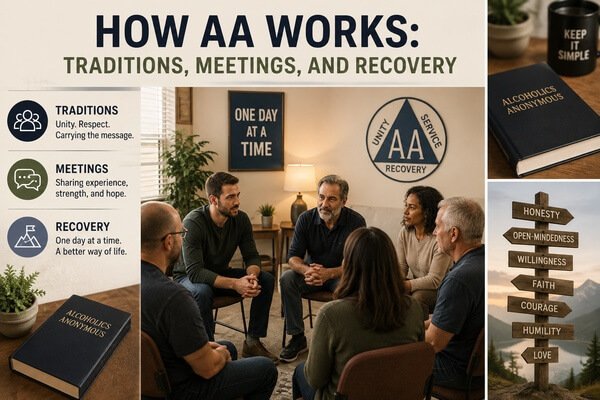
Millions of people have walked into an AA meeting for the first time with no clear idea of what to expect. Some go because a doctor suggested it. Others go because a family member begged them to try. A few go out of pure desperation. Whatever the reason, the experience of sitting in a church basement or community center and listening to strangers talk openly about their relationship with alcohol can be both disorienting and quietly powerful. Understanding how Alcoholics Anonymous is actually structured, what its core principles are, and what science says about its effectiveness can help anyone make a more informed decision about whether it fits into their recovery path.
A Brief History of How AA Came Together
Alcoholics Anonymous was founded in 1935 in Akron, Ohio, when Bill Wilson, a New York stockbroker struggling with alcohol dependency, met with Robert Smith, a local surgeon facing the same battle. Their conversations about sobriety, spirituality, and mutual accountability laid the groundwork for a program that would eventually spread to nearly every country in the world. The founding text, commonly called the Big Book, was published in 1939 and remains central to the AA program today. It outlined a twelve-step process for achieving and maintaining sobriety, a framework that has since been adapted for dozens of other recovery programs addressing everything from drug addiction to compulsive behaviors.
The growth of AA over the following decades was remarkable. By 1950, membership had reached roughly 100,000. According to AA’s own 2023 membership survey, there are now approximately 2 million members across more than 123,000 groups worldwide. That kind of reach did not happen by accident. It happened because the program addressed something real: the isolation and shame that often accompany addiction, and the relief that comes from being in a room with people who genuinely understand.
The Twelve Steps and What They Actually Ask of Members
The twelve steps are the backbone of the AA program, but they are frequently misunderstood by people who have never attended a meeting. They are not a rigid checklist that members complete once and move on. They are meant to be worked through gradually, often with a sponsor, and revisited over time. The steps progress from an admission of powerlessness over alcohol, through a process of moral inventory and making amends, to a commitment to ongoing self-reflection and helping others.
The spiritual language in the steps is where many newcomers hesitate. References to a higher power and prayer can feel alienating to people who are not religious. AA itself, however, does not require belief in any particular God or religious tradition. The phrase ‘higher power’ is intentionally broad. Some members interpret it as the collective wisdom of the group itself. Others find meaning in nature, in art, or in a sense of something larger than individual will. The program has always been flexible on this point, and many atheists and agnostics have found lasting sobriety within it.
The Role of a Sponsor
A sponsor is a more experienced AA member who guides a newcomer through the twelve steps. This relationship is one of the most distinctive features of the program. It is informal, voluntary, and entirely outside any clinical or professional framework. Sponsors share their own experiences, offer accountability, and are available during difficult moments. Research has consistently found that having a sponsor is associated with better outcomes in AA participation. A study published in the journal Alcoholism: Clinical and Experimental Research found that sponsees who maintained regular contact with their sponsors were significantly more likely to remain abstinent at a one-year follow-up.
The Twelve Traditions: How AA Protects Its Mission
Less widely known than the twelve steps, the twelve traditions govern how AA as an organization operates. They were adopted in 1950 to address the practical challenges of running a growing, loosely structured fellowship. The traditions cover things like the importance of anonymity, the prohibition on outside affiliations, and the principle that AA groups should never accumulate significant wealth or property. One of the most significant traditions is that AA has no opinion on outside issues and will never allow its name to be associated with any public controversy. This has helped the organization remain focused and avoid the political entanglements that have undermined other social movements.
For people new to AA, understanding the traditions can clarify some things that might otherwise seem strange. Why does AA decline donations above a small amount? Why do groups resist formal leadership structures? The answers all trace back to hard lessons learned in the early decades of the organization, when unchecked authority and financial disputes threatened to fracture individual groups. The traditions are, in a sense, the institutional memory of those early struggles.
For anyone wanting to understand the opening words spoken at nearly every AA meeting, reading the AA preamble explained offers a clear, detailed look at the text that sets the tone for virtually every gathering, and why those particular words were chosen.
What Happens at an AA Meeting
Meetings vary considerably depending on the group, the location, and the format. Some are open to anyone curious about the program. Others are closed, meaning attendance is limited to people who identify as having a problem with alcohol. Within those broad categories, there are several common formats.
- Speaker meetings: One or more members share their personal story of drinking and recovery. Listeners do not typically share.
- Discussion meetings: A topic related to recovery is chosen, and members take turns sharing their thoughts and experiences.
- Step meetings: The group focuses on one of the twelve steps, reading from the Big Book or other literature and discussing its meaning.
- Big Book meetings: Passages from the founding text are read aloud and discussed.
- Online meetings: Conducted via video or phone, these became widespread during the pandemic and have remained popular for people with limited mobility or transportation.
Most meetings follow a loose ritual: a reading of the preamble, a moment of silence, and the Serenity Prayer. After the main format concludes, members usually linger to talk informally. For newcomers, that informal time after the meeting is often where the most meaningful connections happen. Nobody is required to speak. Many people sit quietly through their first several meetings, simply listening.
What Research Says About AA’s Effectiveness
AA has been studied extensively, and the evidence base has grown stronger over time. A landmark 2020 review published in the Cochrane Database of Systematic Reviews analyzed 27 studies involving over 10,000 participants. It concluded that Alcoholics Anonymous was more effective than other treatments, including cognitive behavioral therapy, at helping people achieve and maintain continuous abstinence. The review found that AA and Twelve-Step Facilitation programs produced abstinence rates roughly double those seen with other approaches at the one-year mark.
That finding was notable because it directly countered a long-standing perception in some clinical circles that AA was merely a social support group with no measurable therapeutic benefit. The mechanisms behind its effectiveness are still being studied, but researchers point to several factors: peer accountability, the replacement of social networks built around drinking with sober ones, the structure provided by working the steps, and the sense of meaning and purpose that many members report gaining from helping others.
| Treatment Approach | Key Mechanism | Evidence Level |
| Alcoholics Anonymous | Peer support, twelve steps, sponsor relationship | High (Cochrane Review, 2020) |
| Cognitive Behavioral Therapy | Thought and behavior restructuring | High (multiple RCTs) |
| Medication-Assisted Treatment | Reduces cravings and withdrawal symptoms | High (FDA-approved options) |
| Motivational Interviewing | Builds intrinsic motivation for change | Moderate to High |
| SMART Recovery | Self-management, science-based tools | Moderate |
It is worth noting that AA is not the right fit for everyone, and no single recovery approach works universally. People with co-occurring mental health conditions, those who have experienced trauma within faith-based environments, or those who simply find the format uncomfortable may benefit more from other options. The good news is that the research landscape now includes multiple well-studied approaches, and most addiction specialists recommend building a recovery plan that draws from more than one source of support.
Getting the Most Out of AA as a New Member
People who get the most out of AA tend to share a few common habits. They attend meetings consistently, especially in the early months. They find a sponsor and actually do the work the steps require rather than just attending meetings passively. They arrive early or stay late to build real relationships with other members. And they give the program time. Most long-term members describe the first year as a process of slowly learning how the program works, not a sudden transformation.
Newcomers sometimes make the mistake of treating meetings as a passive activity, something to check off a list. The people who experience lasting change tend to be the ones who engage actively: asking questions, accepting coffee commitments, reading the literature, and calling their sponsor when the urge to drink is strong rather than waiting until a crisis has passed. The social infrastructure of AA is only as useful as the effort a person puts into building real connections within it.
AA has now been part of the addiction recovery landscape for nearly ninety years. Its staying power comes not from any single charismatic leader or institutional funding, but from a simple structure that allows people in pain to find each other and stay accountable together. Whether someone is exploring AA for the first time or returning after a relapse, understanding how the program actually works, what its traditions mean, and what the evidence says makes it easier to approach with clear expectations rather than myths. That clarity alone can make a significant difference in whether someone gives it a genuine try.